
St. Tammany Parish Civil Portal and Case Details
For parish civil records, the Clerk sends the public to re:SearchLA. Expect to register or sign in. The service offers three main choices: Cases, Filings, and Hearings. Cases works best when you already know the civil file. Filings narrows a document hunt. Hearings can surface a published hearing detail when one is available.
Apply the Civil court-division filter where it shows up. Only open Case Details after the number, parties, description, judicial officer, and location all match. A public result may list filings, documents, hearings, and a case summary. Even so, it is not a promise of full online access. Not every signed paper or exhibit is viewable online. For the official certified record, the clerk is the source, not the result screen.
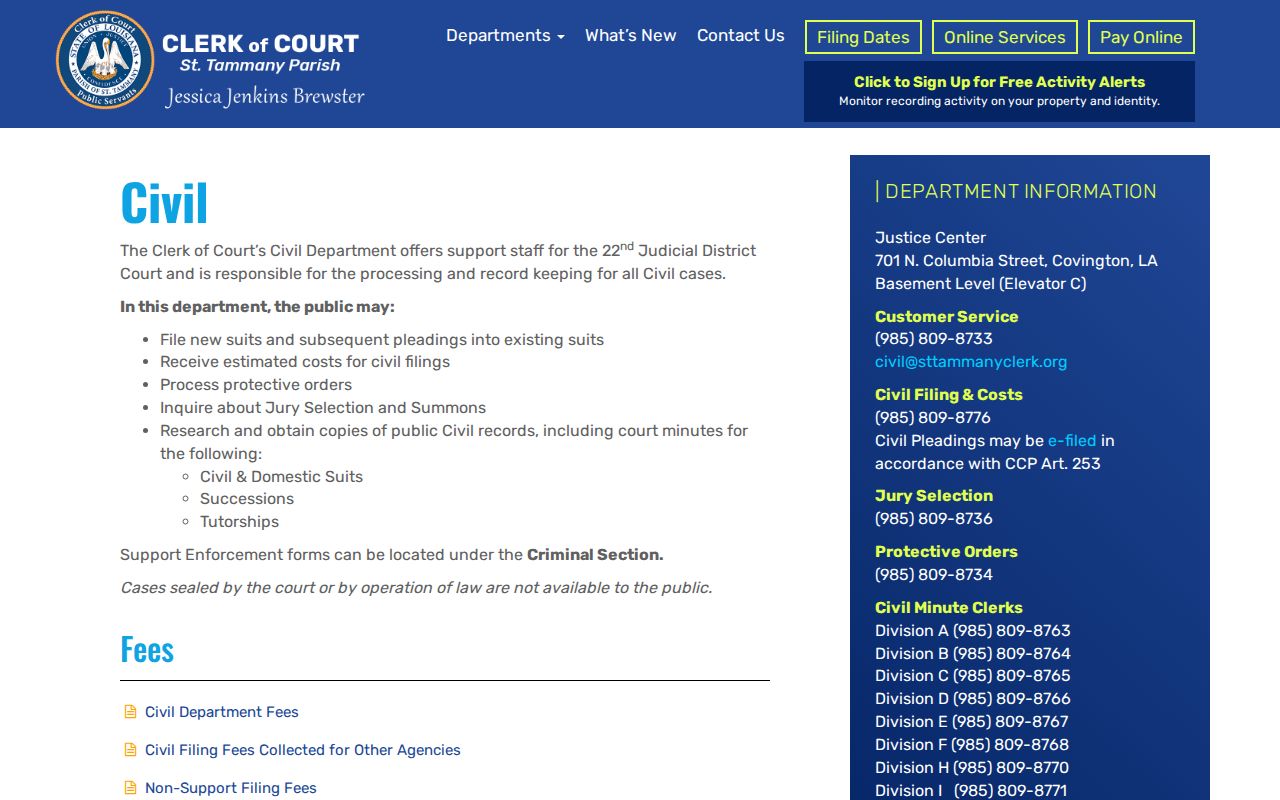
The Clerk’s Civil Department page covers civil-record access, processing notices, forms, and department contacts.
The department’s daily notice earns its keep in civil matters. A new filing can enter the clerk’s workflow before it shows up as a searchable docket entry, so the notice often moves faster than the docket itself.
How to Search Civil Dockets
Begin with whatever court paper you hold: a summons, petition, order, or notice. A 22nd JDC civil, domestic, succession, or tutorship case belongs to the St. Tammany Parish Clerk’s Civil Department. Check the court named on the paper. If it bears a City Court, Justice of the Peace, or Mayor’s Court label, that lower court keeps the local docket. The clerk’s record number is the most reliable key. Without it, search by party name and confirm the case sits in the right division.
- Open the clerk-linked re:SearchLA service and sign in or register when prompted.
- Select Cases and enter the record number, or use the party name in the documented Last Name, First Name format.
- Choose the Civil division where available, then use the case description, party roles, division, and location to distinguish results.
- Open the matching case details and read the petition, service, response, motion, setting, order, and judgment entries in date order.
- Ask the Civil Department for a particular filing, minute, or certified judgment when the online result is incomplete.
The official Smart Search guidance suggests a wildcard for names you are unsure how to spell, like Smi*, J*. Advanced filters include Party, Case, Judgment, Warrant, and Protection Orders. No single St. Tammany Parish civil number pattern is published, so rely on the exact record number printed on the court document.
St. Tammany Parish Civil Processing Dates
The Civil Department puts out a “Status of Daily Civil Filings & Processing” notice. The August 2026 edition split the queue into separate work streams: Civil pleadings, Domestic pleadings, e-Filings, signed orders on continuances, rules, judgments, hearing-officer orders, scanning for rush or daywork, and new suits. Each stream moves at its own pace. Because a filing can sit in one line while its order waits in another, a fresh docket result may not yet show every step. Treat a recent match as a work in progress, not the final word on the case.
A filing date can precede a searchable entry. The Civil Department’s notice states that an item can be filed on one date without being entered or processed that day. Keep the filed paper, check the processing notice, and contact the Civil Department if a time-sensitive St. Tammany Parish civil setting or filing is not yet shown.
What a Civil Docket Shows
A St. Tammany Parish civil docket is a chronological case record. It does not replace the documents in the file. Public case details can show a record number, case type, court division, parties, attorneys, judicial officers, filings, hearings, and a summary. Entries may include service, an answer, a motion, a rule, a setting, a continuance, an order, a judgment, a dismissal, or an appeal. Read the dates in order. When exact wording matters, pull the actual document.
| Record Number | The clerk’s case identifier. The official search materials call it a Record Number and do not publish one civil format for every case type. |
|---|---|
| Parties and roles | May identify plaintiff and defendant, or petitioner and respondent, along with attorneys of record. |
| Filings and service | Can show a petition, answer, exception, motion, rule, citation, service, or related clerk event. |
| Settings | May identify a civil motion, pretrial, bench or jury trial, status conference, hearing-officer event, or later continuance. |
| Judgment and review | Can point to an agreed, default, summary, or other judgment, dismissal, nonsuit, appeal, or post-judgment action. |
St. Tammany Parish Civil Docket Files
Three related products answer different questions about a case. The docket, court minutes, or index is the procedural list of events. A filed document or image sits behind an entry. It may be the petition, answer, motion, order, judgment, exhibit, or transcript. A certified copy is the clerk-certified reproduction of an original record. Keep the distinction in mind with judgments. A judgment line on a St. Tammany Parish civil docket proves a ruling exists. It does not display the full signed judgment.
- Rule to show cause
- An order requiring a person to appear and explain why requested relief should not be granted.
- Continuance or reset
- A movement of a hearing or trial to a new date. Read later notices and orders for the current setting.
- Certified copy
- A clerk-sealed copy certified as a correct copy of the original, distinct from an ordinary online result or plain copy.
Types of Civil Cases on the Docket
The Civil Department keeps 22nd JDC civil and domestic suits, successions, tutorships, and civil or criminal appeals. Public services include taking in new suits and later pleadings, quoting estimated costs, processing protective orders, answering jury-selection questions, and researching public civil records and minutes. Within a St. Tammany Parish civil docket, the case description and division show which route a case took.
- Civil suits and related pleadings
- Domestic matters and protective-order work
- Successions and tutorships
- Appeals handled through the Civil Department
- Post-judgment matters, including garnishment or writ-related events where the record shows them
St. Tammany Parish Civil Court Routing
Not every parish civil case sits in the 22nd JDC Civil Department record system. City Court of East St. Tammany shares civil jurisdiction up to $50,000. It also runs a $5,000 small-claims division. Ward Justice of the Peace courts generally hear claims up to $5,000, plus evictions and movable-property matters. The 22nd JDC handles everything past those limits. Its general trial docket covers major civil cases, family matters, successions, probate, and title to immovable property.
| Type of matter | Likely custodian | Useful routing detail |
|---|---|---|
| 22nd JDC civil, domestic, succession, or tutorship case | St. Tammany Parish Clerk Civil Department | Use the parish civil portal and Civil customer service. |
| East-parish civil case up to the city-court limit | City Court of East St. Tammany | City Court keeps its own civil, small-claims, and eviction docket. |
| Ward limited civil or eviction matter | Relevant Justice of the Peace office | The local JP record is not a parish Civil Department docket. |
| Municipal ordinance matter | Covington or Mandeville Mayor’s Court | These city courts are not the general parish civil docket. |
Settings and Hearings on Civil Dockets
Civil settings come in many forms. A motion, pretrial, bench or jury trial, status conference, or hearing-officer conference can all land on the schedule. Continuances and resets are just as common. The 22nd JDC's court calendar posts division schedules, 2026 calendar links, holidays, and general hearing categories. Treat it as a division schedule. It is not an individual-case search. A jury or bench-trial week on that calendar does not prove your particular case is set that day.
Start with the case notice and the most recent docket or minute entry. The division calendar then explains the session type. The minute clerk, court division, or administrative assistant can confirm the current individual date. Reset fees appear in the 2026 civil fee schedule's continue-and-reset rules. Those fees show resets are routine civil docket activity. Still, no official source publishes a universal parish reset code list.
St. Tammany Parish Civil Document Access
A free case search tells you a filing exists. It rarely delivers every image or signed version. The result may confirm a petition, answer, or judgment without the full document. For the complete item, note the case number, party names, document type, and filing date. Then request it from the Civil Department. The clerk's processing notice also explains delays. A new order, e-filing, or scan may not yet appear in a St. Tammany Parish civil docket.
Need an official copy? Ask for certification. A downloaded image does not carry the clerk's seal on its own. The 2026 civil schedule sets $1 per page for a plain copy. A certified copy is $5 per document plus applicable page fees. The schedule also lists $15 for a record-search certification, $3 for a conformed copy, and $1 per fax page. Because the e-certification PDF has lines that need current clarification, confirm the final total with Civil.
Public Access to Civil Dockets
Louisiana law generally lets the public inspect and copy non-exempt records during regular office hours. The clerk is the legal custodian of court records. That openness has limits online. Not every St. Tammany Parish civil document shows up on the internet. Sealed cases, protected domestic material, adoption-related records, personal identifiers, and anything else shielded by law or court order can be withheld or redacted. A sealed case can return no match in the Clerk's public portal.
Key Louisiana rules:
La. R.S. 44:31 provides the public right to inspect, copy, or reproduce records unless an exemption applies.
La. R.S. 44:32 requires custodians to present public records in regular office hours, provide copies, and identify the legal basis for an exemption.
La. C.C.P. art. 251 identifies the clerk as court-record custodian and authorizes certified copies subject to law.
St. Tammany Parish Civil Copy Form
Civil records and successions from 1986 forward start with the Civil Records Copy Request Form. The form lets you ask for an entire file. It also covers a single item such as a Petition, Answer, or Judgment. You supply the suit or succession number and the plaintiff or defendant name. Add the document type, filing date, the number of copies, and the number to certify.
Civil customer service can give a page count and cost. Call (985) 809-8733 or write Civil@sttammanyclerk.org. Mail the form with a check or money order to Clerk, Attn. Civil Customer Service, P.O. Box 1090, Covington, LA 70434. Copies come back by mail or pickup. The Justice Center at 701 N. Columbia Street in Covington is the in-person civil-record spot. The Slidell Annex offers limited and some fully functional customer service and filing help. Its documents are sent to Covington for civil processing.
St. Tammany Parish Civil Archives Fallback
Does the St. Tammany Parish civil record predate 1986? Skip the active civil search and go to Archives. The civil request form itself points those inquiries to Archives. Call (985) 809-8745 or write Archives@sttammanyclerk.org. The broader archive sits in the Justice Center basement. Its historical holdings serve as an in-person fallback for civil suits, successions, and other record series.
A formal 22nd JDC public-records request goes through Court Administrator Amber Mitchell in Room 3210, 701 N. Columbia Street. Her office takes telephone calls at (985) 809-5300. Faxes go to (985) 809-5390, and email to amitchell@stpgov.org. Give her the case number, parties, requested document, date, and any certification request.
St. Tammany Parish Civil Appeal Entries
A civil judgment rarely ends the story. An appeal, certified judgment request, garnishment, writ of possession or seizure, abstract, or other post-judgment event can follow. Appeals from the 22nd JDC route to the Louisiana Court of Appeal, First Circuit. The parish civil docket still tracks the trial-level chronology well. The appellate court, though, keeps its own file and case number. Confirm the custodian before chasing a later appellate document.