
How to Search the Slidell Court Docket
Match the court first. A citation from Slidell City Court belongs in the Slidell court system. A broad parish search just wastes time. The public Slidell calendar is a standing schedule, not a name or case-number lookup form. For deeper help, the Slidell court's contact page names the public-record custodian. It also lists the court departments. That clerk route is the practical follow-up. Use it whenever someone needs a specific Slidell court docket entry, a date confirmation, or a record missing from the public schedule.
The parish Clerk's re:SearchLA route serves a different custodian entirely. It covers matters filed in the Twenty-Second Judicial District Court, not the city court's calendar. Keep the citation, the court notice, the exact record number, and the case type in hand. Those details keep a Slidell docket search from landing in the wrong place. The official city materials publish no public Slidell name-search portal and no downloadable sample docket. A missing result in a general court portal proves nothing. It tells you nothing about a Slidell city-court case.
- Read the citation or notice and identify City Court of East St. Tammany, the 22nd JDC, or another court before looking for a Slidell record.
- Use the Slidell City Court calendar to identify the standing Slidell session that matches the case type, such as traffic trial, arraignment, eviction, or small claims.
- For an individual Slidell city-court matter, contact the Slidell clerk with the citation or record information and ask the court to confirm the current setting.
- For a 22nd JDC case, use the Clerk's re:SearchLA portal after registration or sign-in, then review Case Details and hearing information when available.
- Compare the newest notice or clerk confirmation with the calendar before appearing, because a standing Slidell docket can change.
Note: A court calendar describes scheduled session blocks. Only the clerk or an individual notice can confirm a particular Slidell case setting.
Slidell Court Docket Calendar
Think of the Slidell court calendar as a monthly standing grid. It is not a searchable case list. The grid names the recurring session types: City Arraignments, City Traffic Trials, State Traffic Trials, City Misdemeanor Trials, State Misdemeanor Trials, Civil Trials, Eviction Hearings, Small Claims Court, probation status or revocation matters, Defer Payment hearings, Special Settings, jail or state arraignments, adoptions, and juvenile sessions. That makes the Slidell court docket calendar handy for decoding what kind of session a notice refers to. It does not show every case set that day.
Changes happen, and the court says so plainly. The Slidell schedule can shift, and scheduled parties get notice from the Clerk. CINC and juvenile custody or hearing-to-answer sessions are marked closed to nonparticipants, and that closed label is an access limit rather than an invitation to hunt for a public case search. If the notice and the monthly grid disagree, trust the notice. Then call the clerk at the court. The City Court's official information display shows the former City Court of Slidell presentation. It carries the Wards 8 and 9 identity.
That court-specific presentation explains the practical rule. A Slidell docket search for a local citation should begin with City Court, not the parish portal.
The Slidell Municipal Court
Slidell's local court is the City Court of East St. Tammany, formerly presented online as City Court of Slidell. It serves all of Wards 8 and 9. That generally means east St. Tammany. The Slidell court keeps its own Slidell dockets for lower-court matters in that territory. Its clerk is the first stop for east-parish matters. That covers a traffic case, a local criminal proceeding, small claims, an eviction, a juvenile matter, or any other City Court file.
Keep this court separate from the St. Tammany Parish Clerk's 22nd JDC departments. A Slidell address alone does not choose the docket. The case type and the court named on the papers do. A parish district-court charge sends the record to the 22nd JDC Criminal Department and the parish Clerk. But a notice bearing City Court of East St. Tammany points straight back to the Slidell court. That means its calendar, ticket process, and clerk.
City Court of East St. Tammany
501 Bouscaren Street
Slidell, LA 70458
(985) 643-1274
Public-record custodian: Clerk Sherry Philips. Court hours are Monday through Friday, 8:30 a.m. to 4:30 p.m.
Slidell Court Docket Scope
The Slidell court docket reaches well beyond tickets. The Slidell court handles traffic violations, DWI, adult criminal matters including domestic violence, possession of marijuana, theft, felony arrest and search warrants, juvenile felonies and misdemeanors, CINC and FINS matters, adoptions, civil lawsuits, small claims, and evictions. CINC means Child in Need of Care; FINS means Family in Need of Services. Those juvenile and family categories can carry special confidentiality limits. That can apply even when another Slidell court record stays public.
The civil limits are specific too. City Court hears civil lawsuits up to $50,000. Small claims top out at $5,000. Anything above those Slidell city-court limits travels a different docket route. So does any district-level criminal case arising in Slidell. The official Slidell court forms material offers eviction and small-claims forms, including a legal-size-paper preference, but no public Slidell case-search form. In the end, the court's jurisdiction decides where the record lives. A generic web search result does not. The City Court's official home display identifies the court's local service area and gives a useful visual check on its separate role.
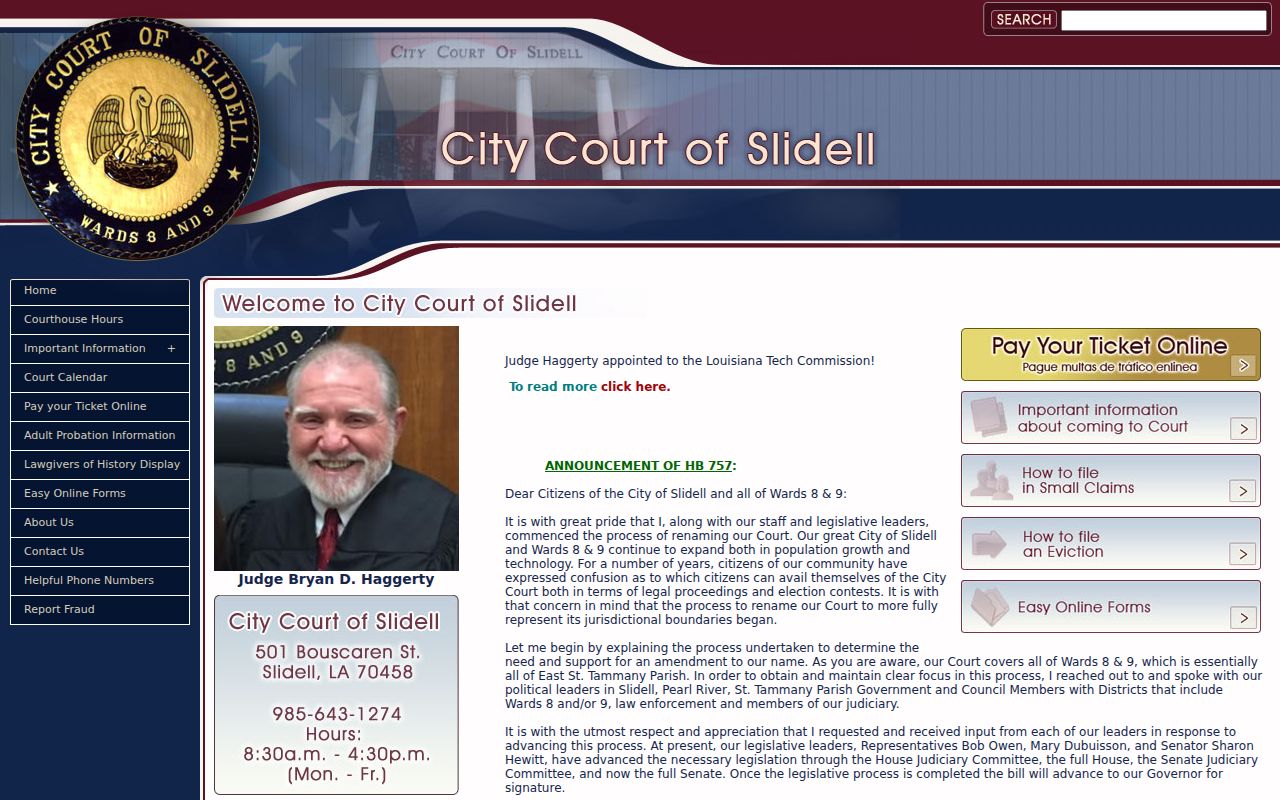
A Slidell court docket can show up on its own, separate from any St. Tammany Parish clerk search result. The Wards 8 and 9 material makes that split clear. One caution: a Slidell case type does not open any doors, since juvenile and sealed records still need the clerk's confirmation before release.
Slidell Court Dates and Settings
Start with the paperwork. For a Slidell court date, the citation, summons, or notice the court sends out ranks above anything else, and the newest notice, minute entry, or clerk confirmation beats older information every time. The court's monthly grid works differently. It labels recurring session types rather than listing case numbers, so it tells you what kind of Slidell hearing might sit on a given day without proving any named case will be heard there. Think of it as an orientation tool. The clerk confirms the individual appearance.
The labels themselves describe real events. A setting is simply a scheduled court event. An arraignment is the appearance where a defendant answers a charge and enters a plea. A continuance or reset shifts a Slidell hearing to a new date. The grid lists City and State traffic trials, City and State misdemeanor trials, probation status or revocation, Defer Payment, Special Settings, civil trials, eviction hearings, small claims, adoptions, and juvenile sessions. None of those labels is a result. It only says what the session is for.
| Date | The date printed on the citation, notice, or current clerk-confirmed setting. |
|---|---|
| Time | The time assigned to the listed Slidell session; the standing grid can identify the session type. |
| Court | City Court of East St. Tammany for Wards 8 and 9 city-court matters. |
| Setting Type | A published label such as arraignment, traffic trial, civil trial, eviction hearing, probation status, or Special Setting. |
| Status | Use the newest notice, minute entry, or clerk confirmation to learn whether the setting remains active or was moved. |
Slidell Court Docket Entry Labels
Slidell posts full setting labels on its public standing calendar. It publishes no list of local abbreviations. Expect entries like City Arraignments, City or State Traffic Trials, City or State Misdemeanor Trials, Civil Trials, Eviction Hearings, Small Claims Court, Probation Revocation or Status, Defer Payment, or Special Settings. Each label names a type of court activity. No label reveals the outcome of a Slidell case.
A few definitions go a long way when reading a docket. A setting is a scheduled appearance or event. An arraignment is the proceeding where a person answers a charge and enters a plea. Probation status or revocation sessions deal with supervision or a possible revocation hearing. Defer Payment is the City Court label for payment arrangements. A Special Setting means the matter was specially assigned or is non-routine. Do not guess at shorthand. Ask the Slidell clerk which label fits an individual docket entry.
- Continuance or reset
- A change that moves a Slidell hearing or trial to another date.
- Disposition
- The recorded outcome, such as a dismissal, judgment, conviction, or other resolution.
- Court minutes
- The clerk-entered record of what occurred in court, distinct from a standing calendar label.
Slidell Traffic Tickets
A Slidell traffic ticket headed to City Court starts with the citation itself and the court's online ticket page. To pay there, you need a few things. Bring the Traffic Citation Number, a supported credit card, an email address, and a printer for the confirmation page. One thing slows people down. The issuing agency has to submit the ticket first. Online payment does not work before that. The court says the step generally takes at least 15 working days. If a ticket is not yet in the system, contact the agency or City Court. Do not retry the search over and over.
Not every ticket can be paid online. Juvenile traffic tickets for drivers age 17 and under require an appearance. So do court-mandatory tickets and some tickets whose appearance date has passed. The court names minor speeding, red-light, failure-to-signal, and failure-to-yield violations as possibly eligible. The citation and the court's own determination still control. The online service adds a non-refundable 5% processing fee. At the lobby help desk, in-person payments can use a credit card, cashier's check, money order, or cash. Personal checks are not accepted. To pay by mail, send the signed ticket and payment to the address on the citation.
Whatever route you choose, payment should reach the court by the scheduled appearance date. Paying or contesting is a decision about that specific Slidell citation, not just a way to clear a calendar entry. Need the parish-wide picture? See St. Tammany Parish traffic court records for the breakdown of traffic custodians and the difference between a court file and an OMV driver file.
Slidell Court Docket Payment Methods
Slidell City Court lays out three payment paths for an eligible citation. Online, you use the Traffic Citation Number and pay a non-refundable 5% processing fee. The lobby help desk takes credit cards, cashier's checks, money orders, and cash. A 5% card fee applies there too. Personal checks are turned away at the desk. By mail, the court wants the signed ticket and payment sent to the address printed on it.
None of these channels replaces the court calendar. First confirm the citation is actually in the city-court system. Check that the issuing agency submitted it. Also check that the ticket qualifies for the route you want. A court-mandatory charge, a juvenile ticket, or a passed appearance date can all knock out the online option. The clerk can explain the current payment route. But be careful: under the court's FTA rule, a payment can waive a hearing and count as a guilty plea. Confirm the Slidell court's current instruction before sending money.
Where Slidell Cases End Up
Slidell legal matters split across several courts rather than one parish docket. The City Court of East St. Tammany sits in Slidell. It holds jurisdiction over its own east-parish cases. Matters filed in the 22nd JDC take a different route. They go through the St. Tammany Parish Clerk's Civil or Criminal Department. That district court handles the parish-level categories the Clerk maintains: civil, domestic, succession, probate, felony, misdemeanor, juvenile, non-support, traffic, and appeals. A ward Justice of the Peace court rounds things out. It keeps a limited local civil and eviction docket of its own.
Docket flow: Slidell City Court matter › City Court clerk/calendar or ticket process; 22nd JDC matter › St. Tammany Parish Clerk and re:SearchLA; appeal from a 22nd JDC judgment › Louisiana Court of Appeal, First Circuit.
Where a case lands hinges on the paperwork, the charge, and how much money is at stake. A parish-wide portal can bury a City Court record. That can happen even when the event occurred right in Slidell. Check the right court first. For anything filed in the 22nd JDC, the St. Tammany Parish court docket overview points you to the Clerk's channel and the correct district-court division for that docket search.
Slidell Court Docket After a Missed Date
Miss a Slidell traffic court date and City Court spells out what comes next. The court treats an unpaid ticket past its court date as an FTA, short for failure to appear, or as a contempt attachment. Either way, it works like an arrest warrant. DMV gets notified, and the license is suspended. The fees climb with each slip, and a first FTA costs $250. A second costs $500. A third means you must appear in court rather than pay. If the court still allows payment after the missed date, you owe the citation plus the FTA fee. Then DMV charges its own reinstatement fees.
One more thing matters here. The official payment page states that paying after an eligible missed date waives your hearing. It counts as a guilty plea. A Slidell court docket entry alone will not clear this up. Check the citation and the court's current instructions. Let the clerk confirm whether payment can still resolve the ticket or whether an appearance is required.
Missed Slidell traffic date: Contact City Court promptly with the citation information. A late payment is not available for every case, and the court's FTA rules can add both court and license consequences.
Public Access to Slidell Court Records
Public access starts with the court holding the Slidell record. Sherry Philips serves as the City Court public-record custodian. Ask the Slidell City Court for its own records, minutes, or copies. The parish Clerk's re:SearchLA link helps with 22nd JDC records. It does not promise access to each lower-court docket. An online index is not a certified record either. When you need an official copy, request it from the custodian maintaining the file.
Louisiana access rules carry real limits. Juvenile, CINC, adoption, sealed, expunged, protected domestic, and sensitive personal or victim information may be confidential or redacted. A sealed search can return no match. That result does not prove a Slidell case never existed. Court minutes and filings are different layers of the record. An online entry can lag processing. Confirm the record and its current access status with the City Court clerk or the parish clerk that holds it.
Key Rules:
Louisiana R.S. 44:31 recognizes the public right to examine or copy non-exempt public records.
Louisiana R.S. 44:32 addresses a custodian's inspection, copying, fee, and exemption-notice duties.
Louisiana Code of Civil Procedure art. 251 identifies the clerk's custodial role and provides for public court-record inspection and certified copies.
Louisiana Children's Code art. 412 makes juvenile records and reports confidential except for authorized disclosures.
Note: For a Slidell court record, the custodian holding the original file is where an official copy comes from.
Slidell Court Docket Courtroom Rules
Getting to a Slidell docket setting takes more than finding the date. City Court runs airport-style scanning and a metal detector at the door. The court bans weapons and sharp or caustic items. Also banned are food and drinks, alcohol, and drugs other than prescribed medication. Phones and other electronics are turned away. So are recording devices without written judge permission. These rules are simply part of appearing in person when a Slidell notice requires it.
Parking is free next door, with accessible spaces. That convenience changes nothing about your date or docket status. The current citation, notice, and Slidell clerk still control the case-specific appearance instruction. Anyone facing a closed juvenile or CINC session should not read the published calendar as permission. Nor is physical court access permission to attend.